
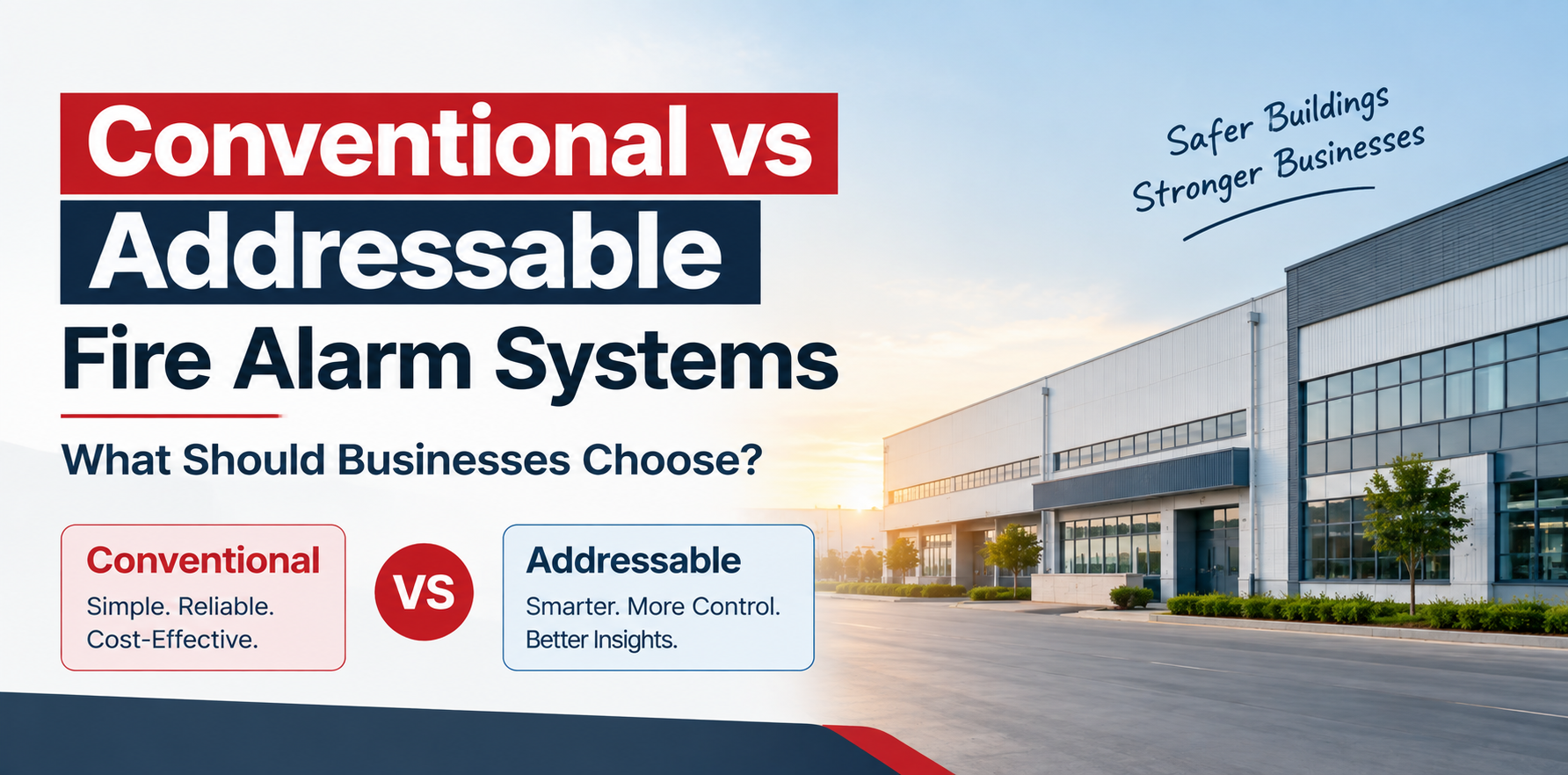

The installation of a fire alarm system that is effective will be very important in helping to ensure proper fire safety at the facility. This is because it ensures that possible risks from any fire-related accident are detected and minimised.
One question that might arise is whether a conventional or an addressable fire alarm system should be installed. These two systems can both help detect fires; however, they differ.
What Is a Conventional Fire Alarm System?
The traditional fire alarm system breaks down a building into different zones, within which many types of smoke, heat, and manual detectors can be connected to each other.
Upon activation of the detector, the fire alarm control panel indicates that there is a fire in the specific zone but not the detector.
For instance, upon the activation of a detector in Zone 3, the control panel informs about the fire in Zone 3, but one needs to figure out the actual place of the fire.
Key advantages
- Relatively easier to install and use
- Appropriate for buildings of smaller sizes and simple configurations
- It can be economical in certain situations
- Simple zone-based identification system
What Is an Addressable Fire Alarm System?
An addressable fire alarm system is one that uses unique addresses for the devices connected to it. If any detector or manual call point is triggered, the control panel can recognise the specific device and location.
This level of detail may prove very useful in the event of emergencies on larger, more complex premises.
Key Advantages
- Provides more accurate device identification
- Is appropriate for larger and more complicated premises
- Facilitates easy identification of faults
- Can incorporate more sophisticated monitoring and system features
Conventional vs Addressable: Key Differences
| Feature | Conventional System | Addressable System |
| Detection identification | Zone level | Individual device level |
| Installation | Generally simpler | More technically advanced |
| Typical application | Smaller/simple facilities | Larger/complex facilities |
| Fault identification | More zone-based | More precise |
| Expansion | Depends on panel capacity | Often highly flexible |
| Initial cost | Typically lower | Typically higher |
Which Fire Alarm System Should a Business Choose?
No universal solution will be suitable for all types of companies and organisations. This will depend on several factors, including the building’s size, configuration, occupancy, fire risk, number of detection zones, operating requirements, growth plans, and budget.
If your company is a small office, shop, or small facility with a simple layout, you may not need to go beyond the conventional system. If you have a large factory, warehouse, hotel, hospital, university, or multi-zone building, you will get additional benefits from the addressable system’s features.
At the same time, one should consider the facility’s future needs and not choose a system solely based on installation costs.
Start with a proper assessment to choose a Suitable Fire Alarm System
When deciding which of these fire alarm systems will suit you better, conventional or addressable. You first need a professional assessment of your facilities and fire risks. The system should be correctly designed, installed, tested, and maintained in accordance with the requirements and instructions.
Palladium Fire Safety Solutions offers fire safety solutions to businesses and industries, helping them establish fire protection measures that meet their needs.
